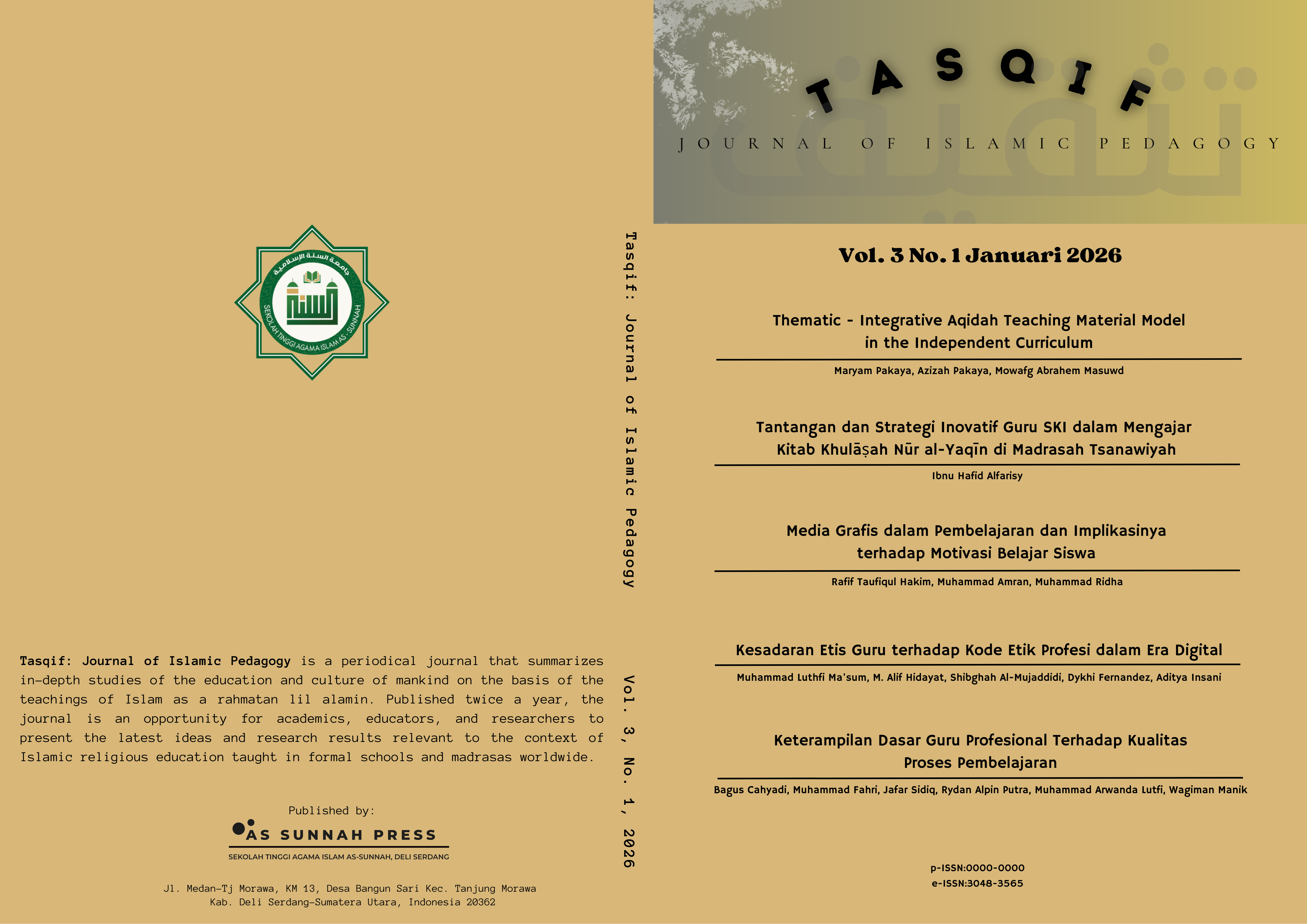
Kesadaran Etis Guru terhadap Kode Etik Profesi dalam Era Digital
DOI:
https://doi.org/10.51590/tsqf.v3i1.60Keywords:
Ethical Awareness, Teachers’ Code of Ethics, Digital Era, Professional EthicsAbstract
The development of digital technology has brought significant changes to teachers’ professional practices while simultaneously presenting new challenges in the implementation of professional ethics in education. Learning processes that increasingly take place in digital environments require teachers not only to possess pedagogical competence and digital literacy but also a strong ethical awareness in applying professional codes of ethics. This study aims to analyze the level of teachers’ ethical awareness of professional codes of ethics within the context of education in the digital era. The study employs a descriptive qualitative approach combining a literature review with limited field data collection. The literature review was conducted through the examination of scholarly journals and documents on teachers’ professional codes of ethics, while field data were obtained through the distribution of questionnaires and limited interviews with teachers. This approach was adopted to gain a comprehensive understanding of teachers’ perceptions and practices regarding professional ethics in digital learning environments. The findings indicate that teachers’ ethical awareness ranges from moderate to good; however, its implementation in digital contexts continues to face various challenges. The results reveal a gap between normative understanding of professional codes of ethics and teachers’ professional practices in the use of digital media. The main challenges identified include limited understanding of digital ethics, weak professional boundaries, and the influence of school culture as well as the dynamics of technological development. Therefore, this study emphasizes the importance of strengthening teachers’ professional ethics as a foundation for professionalism and educational integrity in the digital era.
References
Ayenalem, K, S Abate, H Ayalew, and J Mengesha. “Secondary School Teachers’ Code of Ethics in Ethiopia: Implications for Policy and Practice.” Heliyon 8 (2022). https://doi.org/10.1016/j.heliyon.2022.e10885.
Baydar, F, and A Levent. “Ethical Review on Teachers’ Relations with the School Environment.” International Journal of Educational Research Review, 2023. https://doi.org/10.24331/ijere.1336456.
Cronqvist, M. “Teachers’ Ethical Responsibility in Teaching; To Guide the Children about Right and Wrong.” Scandinavian Journal of Educational Research 69 (2024): 857–70. https://doi.org/10.1080/00313831.2024.2360901.
Fatonah, S. “Problematika Profesionalisme Keguruan Dan HAM Dalam Perspektif Kode Etik Guru (Studi Fenomena Kekerasan Secara Fisik Kepada Siswa Di Indonesia Tahun 2022).” Jurnal Kependidikan 11, no. 1 (2023). https://doi.org/10.24090/jk.v11i1.4955.
Ghiatau, R, and L Mâță. “Factors Influencing Higher Education Teachers’ Attitudes towards Unethical Use of Information Technology: A Review.” Revista Romaneasca Pentru Educatie Multidimensionala, 2019. https://doi.org/10.18662/rrem/111.
Junaidin, J. “Etika Profesi Guru Pendidikan Agama Islam Sebagai Sistem Kontrol Di Era 5.0.” EL-HIKMAH: Jurnal Kajian Dan Penelitian Pendidikan Islam 17, no. 1 (2023). https://doi.org/10.20414/elhikmah.v17i1.8426.
Kalimullina, O, B Tarman, and I Stepanova. “Education in the Context of Digitalization and Culture: Evolution of the Teacher’s Role, Pre-Pandemic Overview.” Journal of Ethnic and Cultural Studies, 2020. https://doi.org/10.29333/ejecs/629.
Karataş, K, and N Yilmaz. “Evaluating Prospective Mathematics Teachers’ Development of Ethical Knowledge and Awareness.” Research in Pedagogy, 2021. https://doi.org/10.5937/istrped2102377k.
Kunci, K, E Profesi, K Keguruan, A Hadits, and K Alqur’an. “Etika Profesi Keguruan Dalam Tinjauan Alqur’an Dan Hadits.” Journal of Educational Management and Strategy 1, no. 2 (2022). https://doi.org/10.57255/jemast.v1i2.62.
Markauskaite, L, L Carvalho, and T Fawns. “The Role of Teachers in a Sustainable University: From Digital Competencies to Postdigital Capabilities.” Educational Technology Research and Development 71 (2023): 181–98. https://doi.org/10.1007/s11423-023-10199-z.
Maulana, Iqbal, Nia Atikah Rahma, Namira Fitri Mahfirah, Wahyu Alfarizi, and Ahmad Darlis. “Meningkatkan Profesional Guru Dengan Program Pendidikan Profesi Guru (PPG).” Journal on Education 5, no. 2 (2023): 2158–67. https://doi.org/10.31004/joe.v5i2.867.
Mouta, A, E Torrecilla-Sánchez, and A Pinto-Llorente. “Comprehensive Professional Learning for Teacher Agency in Addressing Ethical Challenges of AIED: Insights from Educational Design Research.” Education and Information Technologies 30 (2024): 3343–87. https://doi.org/10.1007/s10639-024-12946-y.
Mufidah, N, and L L. “Enhancing Teacher Competence in the Digital Age: Challenges and Strategies.” ICONIC: Journal of Islamic Studies, 2025. https://doi.org/10.59166/h892wm89.
Novella-García, C, and A Cloquell-Lozano. “The Ethical Dimension of Digital Competence in Teacher Training.” Education and Information Technologies 26 (2021): 3529–41. https://doi.org/10.1007/s10639-021-10436-z.
Radianti, R, I Ramadhan, A Amal, and A Nasution. “Kode Etik Profesi Guru Di Era Globalisasi: Menghadapi Tantangan Dan Peluang.” Ability: Journal of Education and Social Analysis 5, no. 2 (2024). https://doi.org/10.51178/jesa.v5i2.1925.
Rahayu, W, E Tazkiyah, N Murtadho, and S Arifin. “The Role of Teacher Ethics in Developing Student Character in School.” Jurnal Ilmiah Sekolah Dasar 7, no. 3 (2023). https://doi.org/10.23887/jisd.v7i3.55245.
Rajbhandari, J, and K Rana. “Cyberbullying on Social Media: An Analysis of Teachers’ Unheard Voices and Coping Strategies in Nepal.” International Journal of Bullying Prevention, 2022, 1–13. https://doi.org/10.1007/s42380-022-00121-1.
Simanjorang, B, L Situmorang, T Salsabila, N Panggabean, and S Yunita. “Peran Mata Kuliah Etika Profesi Keguruan Dalam Pembentukan Karakter Dan Praktik Profesional Mahasiswa Calon Guru Di Indonesia.” Journal on Education 6, no. 4 (2024). https://doi.org/10.31004/joe.v6i4.6333.
Wang, M, and J Tan. “A Study of Factors Influencing Digital Ethical Literacy among Elementary and Secondary Pre-Service Teachers: A Structural Equation Modeling Analysis.” Journal of Combinatorial Mathematics and Combinatorial Computing, 2025. https://doi.org/10.61091/jcmcc127b-456.
Downloads
Published
Issue
Section
License
Copyright (c) 2026 Muhammad Luthfi Ma'sum, M. Alif Hidayat, Shibghah Al-Mujaddidi, Dykhi Fernandez, Aditya Insani

This work is licensed under a Creative Commons Attribution 4.0 International License.