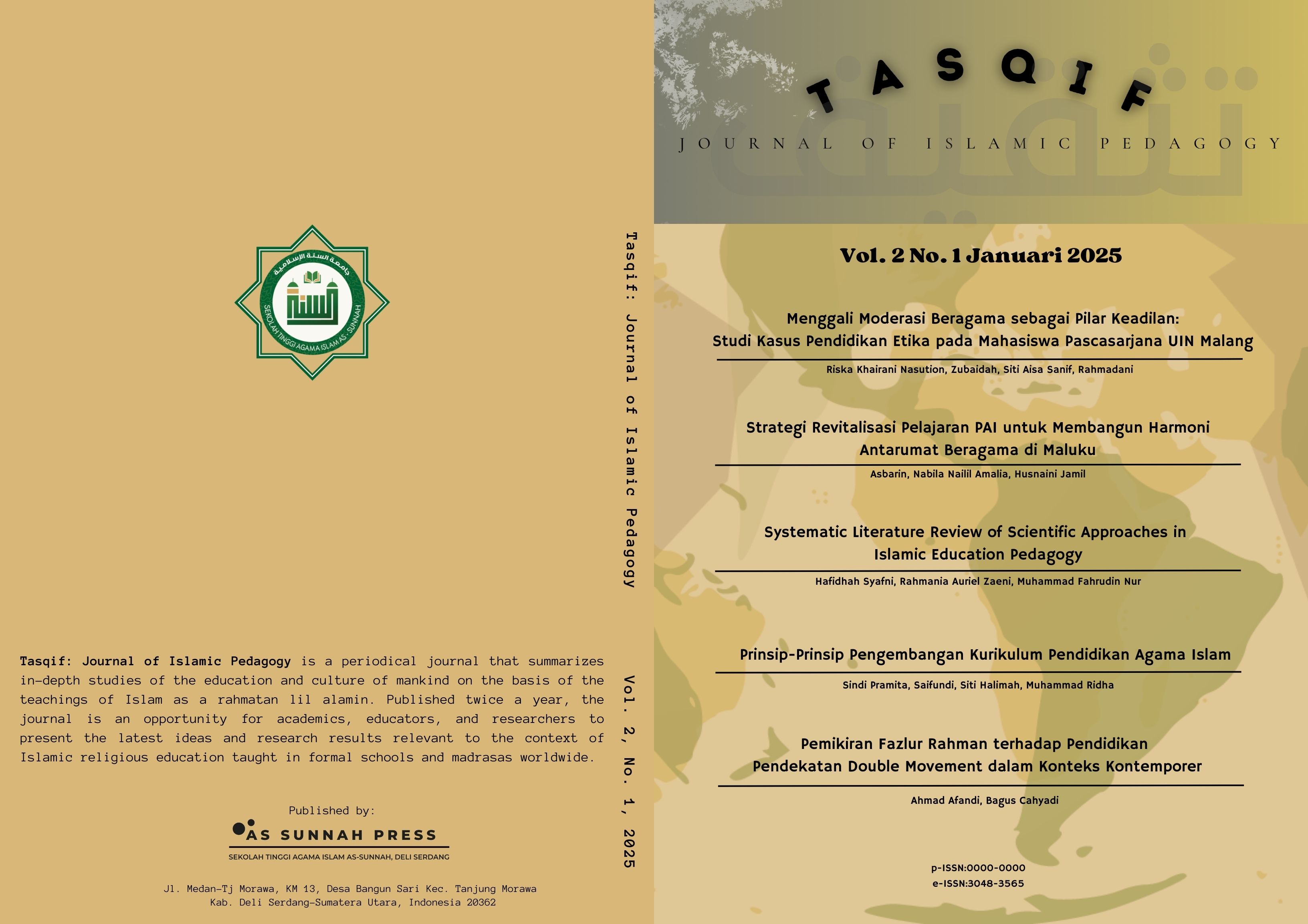
Pemikiran Fazlur Rahman terhadap Pendidikan Islam
Pendekatan Double Movement dalam Konteks Kontemporer
DOI:
https://doi.org/10.51590/tsqf.v1i1.9Kata Kunci:
Fazlur Rahman, Islamic Education, Double Movement, Knowledge IntegrationAbstrak
This study examines Fazlur Rahman's thoughts on Islamic education reform through the double movement method, which aims to integrate the historical understanding of Qur'anic revelation with its application to modern challenges. Using a descriptive qualitative approach based on literature analysis, this research explores the implementation of the method in Pakistan, Indonesia, and Malaysia. The findings show that the double movement method provides a foundation for designing a curriculum that is relevant to contemporary needs without abandoning Islamic values. In Pakistan, Rahman faced resistance from conservative groups, although his ideas continued to influence modern educational discourse. In Indonesia, the transformation of IAIN into UIN reflects the adoption of integration concepts, while Malaysia, through the International Islamic University Malaysia (IIUM), successfully adopted a holistic approach despite encountering similar challenges. This study concludes that the double movement method holds significant potential to address the challenges of globalization in Islamic education, provided it is supported by inclusive dialogue and a commitment to integrating religious values with modern knowledge.
Referensi
Esposito, John L. The Islamic Threat : Myth or Reality? New York : Oxford University Press, 1993. http://archive.org/details/islamicthreat00john.
Hamka. “Reformulation of the Epistemology of Islamic Education: Examine Noeng Muhadjir’s Thoughts.” Edukasi Jurnal Pendidikan Islam (E-Journal) 9, no. 2 (2021): 169–83. https://doi.org/10.54956/edukasi.v9i2.33.
Hapidin, Ahmad, Nanat F. Natsir, dan Erni Haryanti. “The Challenge of Science in Islamic Education in Era 4.0.” Jurnal Alwatzikhoebillah Kajian Islam Pendidikan Ekonomi Humaniora 8, no. 1 (2022): 41–57. https://doi.org/10.37567/alwatzikhoebillah.v8i1.995.
Ichsan, Ahmad S. “Contextualization of Fazlur Rahman’s Thought Towards the Curriculum of Merdeka Belajar in Primary Education.” Sicee 1, no. 0 (2023): 171. https://doi.org/10.24235/sicee.v1i0.14569.
Janah, Nasitotul, dan Irham Nugroho. “Fazlur Rahman’s Thoughts of Double Movement in the Context of the Development of Unity of Sciences.” Jurnal Tarbiyatuna 13, no. 1 (2022): 63–81. https://doi.org/10.31603/tarbiyatuna.v13i1.5718.
Muhammad Mumtaz Ali. “ISLAMIZATION OF HUMAN KNOWLEDGE FROM PROF KAMAL HASSAN’S PERSPECTIVE.” Revelation and Science 13, no. 2 (28 Desember 2023). https://doi.org/10.31436/revival.v13i2.365.
Raḥmān, Fazlur. Islam & Modernity: Transformation of an Intellectual Tradition. 8. impr. Publications of the Center for Middle Eastern Studies 15. Chicago London: Univ. of Chicago Press, 2002.
Rahman, Fazlur. Major Themes of the Qurʼān. Minneapolis : Bibliotheca Islamica, 1980. http://archive.org/details/majorthemesofqur0000rahm_r1c5.
Rozaq, Abd. “Qur’anic Hermeneutics and Its Applications by Fazlur Rahman.” Ijiss 1, no. 2 (2023): 115–24. https://doi.org/10.62039/ijiss.v1i2.27.
Saeed, Abdullah. Interpreting the Qur’an: Towards a Contemporary Approach. Routledge, 2005.
Sardar, Ziauddin. Reading the Qur’an: The Contemporary Relevance of the Sacred Text of Islam. Oxford University Press, 2017.
Syed Muhammad Naquib Al-Attas. Prolegomena-to-the-Metaphysics-of-Islam-Syed-Muhammad-Naquib-al-Attas, 1995. http://archive.org/details/prolegomena-to-the-metaphysics-of-islam-syed-muhammad-naquib-al-attas.
The Concept Of Education In Islam - Syed Muhammad Naquib al-Attas. Diakses 23 November 2024. http://archive.org/details/the-concept-of-education-in-islam.
“The Relevance of Fazlur Rahman’s Concept of Education to the Independent Learning Curriculum.” International Journal of Social Science Humanity & Management Research 2, no. 12 (2023). https://doi.org/10.58806/ijsshmr.2023.v2i12n09.
Turhamun. “Fazlur Rahman Perspective on the Science Concept.” Fikroh Jurnal Pemikiran Dan Pendidikan Islam 16, no. 1 (2023): 45–52. https://doi.org/10.37812/fikroh.v16i1.689.
Unduhan
Diterbitkan
Terbitan
Bagian
Lisensi
Hak Cipta (c) 2025 Ahmad Afandi, Bagus Cahyadi

Artikel ini berlisensi Creative Commons Attribution 4.0 International License.