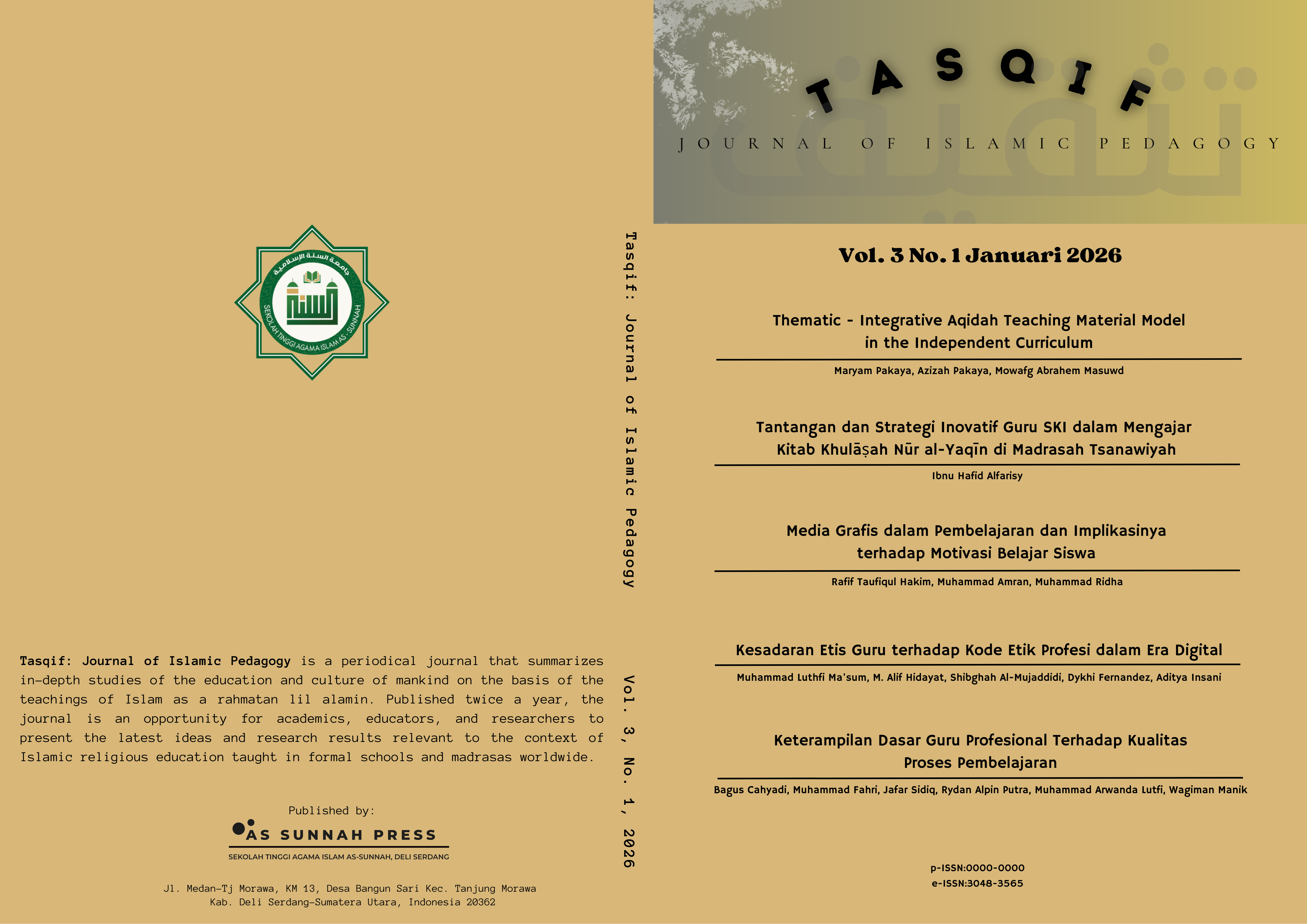
Tantangan dan Strategi Inovatif Guru SKI dalam Mengajar Kitab Khulāṣah Nūr al-Yaqīn di Madrasah Tsanawiyah
DOI:
https://doi.org/10.51590/tsqf.v3i1.77Keywords:
Islamic Cultural History, Khulāṣah Nūr al-Yaqīn, Pedagogical Content Knowledge, classical Arabic texts, innovative learningAbstract
This research aimed to explore the challenges inherent in teaching Islamic Cultural History (SKI) through the classical Arabic text Khulāṣah Nūr al-Yaqīn, while also examining novel strategies grounded in Pedagogical Content Knowledge (PCK) utilized by SKI instructors at MTs Al Irsyad Tengaran 7, Batu City. Employing a qualitative case study methodology, data were gathered via comprehensive interviews with SKI teachers possessing master’s degrees, alongside an analysis of instructional materials, and subsequently analyzed through thematic analysis. The results of this study identified six primary challenges: students’ historical misunderstandings, the restricted scope of textual coverage, the prevalence of lecture–translation approaches, the limited efficacy of instructional media, the substantial workload teachers face in supplementing references, and the complexities of classroom management. To surmount these obstacles, the teacher formulated four interconnected PCK -based strategies: contextual storytelling incorporating multi-classical references, the utilization of authentic visual media, interactive apperception via real-life analogies, and the elevation of teacher professionalism. Theoretically, this study strengthened the conceptualization of domain-specific PCK in teaching classical Arabic texts within the context of Islamic secondary education. Practically, the results underscored the necessity for focused teacher training, curriculum design, and additional research concerning classical text-based learning across varied madrasah settings.
References
Ahmad, I F, N H P S Putro, Z S Thontowi, A Syafii, and M A Subakti. “Trends in the Implementation of Higher-Order Thinking Skills in Islamic Religious Education in Madrasahs and Schools: A Systematic Literature Review.” Jurnal Pendidikan Islam 9, no. 2 (2020): 195–216. https://doi.org/10.14421/jpi.2020.92.195-216.
Almonacid-Fierro, Alejandro, Sergio Sepúlveda-Vallejos, Karla Valdebenito, Noelva Montoya-Grisales, and Mirko Aguilar-Valdés. “Analysis of Pedagogical Content Knowledge in Science Teacher Education: A Systematic Review 2011-2021.” International Journal of Educational Methodology 9, no. 3 (2023). https://doi.org/10.12973/ijem.9.3.525.
Amir, S. “Problematika Pembelajaran Kitab Kuning Di Pesantren Putra Alkhairaat Pusat Palu.” Al-Qalam: Jurnal Keagamaan Dan Sosial Budaya 26, no. 1 (2020): 141–54. https://doi.org/https://doi.org/10.31969/alq.v26i1.827.
Aprilia, I, Nelson, S Rahmaningsih, and Idi Warsah. “Implementasi Metode Pembelajaran Bervariasi Pada Materi SKI Di Madrasah Ibtidaiyyah.” JIP (Jurnal Ilmiah PGMI) 6, no. 1 (2020): 49–62. https://doi.org/https://doi.org/10.29240/ajis.v6i1.2328.
Asmardi, and M Pasaribu. “Penggunaan Strategi Bercerita Pada Materi Sejarah Kebudayaan Islam Di MTs Nurul Falah Sibiruang Koto Kampar Hulu.” EduInovasi: Journal of Basic Educational Studies 4, no. 1 (2024): 327–45. https://doi.org/10.47467/eduinovasi.v4i1.5199.
Ausubel, David P. “The Use of Advance Organizers in the Learning and Retention of Meaningful Verbal Material.” Journal of Educational Psychology 51, no. 5 (1960). https://doi.org/10.1037/h0046669.
Biggs, John. “Enhancing Teaching through Constructive Alignment.” Higher Education 32, no. 3 (1996). https://doi.org/10.1007/BF00138871.
Bruner, Jerome. “The Narrative Construction of Reality.” Critical Inquiry 18, no. 1 (1991). https://doi.org/10.1086/448619.
Chevallard, Yves. “Sobre a Teoria Da Transposição Didática: Algumas Considerações Introdutórias (On Didactic Transposition Theory: Some Introductory Notes).” Revista de Educação, Ciências e Matemática 3, no. 2 (2013).
Clark, James M., and Allan Paivio. “A Dual Coding Perspective on Encoding Processes.” In Imagery and Related Mnemonic Processes, 1987. https://doi.org/10.1007/978-1-4612-4676-3_1.
Endan Hamdan Ridwan, Tedi Gandara, and Diansyah Permana. “IMPLEMENTASI PENDIDIKAN AGAMA ISLAM DALAM BELAJAR BAHASA ARAB KITAB KUNING.” Al-Hasanah : Jurnal Pendidikan Agama Islam 9, no. 2 (2024). https://doi.org/10.51729/92907.
Fuadi, S. “Strategi Guru Sejarah Islam Dalam Mengajarkan Kitab Khulāshah Nūr Al-Yaqīn Pada Santri Kelas 2 Mts Di Dayah Modern Darul Ulum.” Tadabbur: Jurnal Peradaban Islam 3, no. 2 (2021): 550–63. https://doi.org/10.22373/tadabbur.v3i2.396.
Gibson, James J. “The Ecological Approach to the Visual Perception of Pictures.” Leonardo 11, no. 3 (1978). https://doi.org/10.2307/1574154.
Hubbard, Aleata. “Pedagogical Content Knowledge in Computing Education: A Review of the Research Literature.” Computer Science Education 28, no. 2 (2018). https://doi.org/10.1080/08993408.2018.1509580.
Ibrahim Dalimunthe, F, H A Nasution, and M S A Lubis. “Strategi Guru Dalam Mengatasi Kesulitan Belajar Siswa Pada Mata Pelajaran Sejarah Kebudayaan Islam Di Mts Ummul Quraa Medan Tembung.” Hijaz: Jurnal Ilmu Ilmu Keislaman 1, no. 4 (2022): 15–19. https://doi.org/https://doi.org/10.57251/hij.v1i4.530.
Ilma, F, Sulalah, and S Susilawati. “Transformation of Islamic Cultural History Learning through Wordwall Media: Interactive Solutions to Improve Student Motivation and Learning Outcomes in the Digital Era.” Educazione: Journal of Education and Learning 2, no. 1 (2024): 38–51. https://doi.org/10.61987/educazione.v2i1.544.
Istiqomah, N, S Ibnu Rusyd Tanah Grogot, and P.-K. Timur. “Reinterpretasi Metode Pembelajaran Sejarah Kebudayaan Islam: Optimalisasi Implementasi Dalam Kurikulum 2013 Di Madrasah Aliyah.” IQRO: Journal of Islamic Education 6, no. 1 (2023). https://doi.org/https://doi.org/10.24256/iqro.v6i1.4084.
Kartika, I, I Fabianza, and A A Sunasa. “Analisis Pengaruh Desain Pembelajaran Berbasis Teknologi Informasi Dan Persepsi Guru Terhadap Hasil Belajar Sejarah Kebudayaan Islam Siswa Madrasah Tsanawiyah Islam Terpadu Bogor.” EduInovasi: Journal of Basic Educational Studies 4, no. 1 (2024): 485–98.
Litman, Jordan A. “Curiosity and the Pleasures of Learning: Wanting and Liking New Information.” Cognition and Emotion, 2005. https://doi.org/10.1080/02699930541000101.
Magnusson, Shirley, Joseph Krajcik, and Hilda Borko. “Nature, Sources, and Development of Pedagogical Content Knowledge for Science Teaching.” In Examining Pedagogical Content Knowledge, 2006. https://doi.org/10.1007/0-306-47217-1_4.
Maula, N, A Sopian, and S M Khalid. “Exploring Pedagogical Content Knowledge in Improving Learning Outcomes at Al-Musyawarah Islamic High School Bandung.” Uktub: Journal of Arabic Studies 5, no. 1 (2025): 119–35. https://doi.org/https://doi.org/10.32678/uktub.v5i1.22.
Mayer, Richard E. “Incorporating Motivation into Multimedia Learning.” Learning and Instruction 29 (2014): 171–73.
Melvarisa, R, J Junaidi, and H Ariza. “Pengembangan Bahan Ajar Sejarah Kebudayaan Islam Berbasis Higher Order Thinking Skill Di MTS Diniyyah Pasia.” Tapis : Jurnal Penelitian Ilmiah 7, no. 1 (2023): 93. https://doi.org/10.32332/tapis.v7i1.7523.
Nasution, A G J, T Aina, and R Prayudha. “Upaya Guru Dalam Mewujudkan Pembelajaran SKI Yang Menyenangkan Di MIN 1 Medan.” Januari 3, no. 1 (2023): 126–32. https://doi.org/10.58578/masaliq.v3i1.
Nurvina Darise, G, and E Mandiri. “Implementasi Kurikulum Merdeka Pada Mata Pelajaran Sejarah Kebudayaan Islam Di Madrasah Daerah 3 T.” Paedagogie: Jurnal Pendidikan Dan Studi Islam 6, no. 02 (2025): 1–16. https://doi.org/10.52593/pdg.06.2.01.
Park, Soonhye, and J. Steve Oliver. “Revisiting the Conceptualisation of Pedagogical Content Knowledge (PCK): PCK as a Conceptual Tool to Understand Teachers as Professionals.” Research in Science Education 38, no. 3 (2008). https://doi.org/10.1007/s11165-007-9049-6.
Putra, S, D Heraldo, M Rizaq, M S Kurdi, N Nasiruddin, and M R Althafullayya. “Strategies of Religious Teachers to Overcome Students’ Difficulties in Learning Islamic History.” Al-Hijr: Journal of Adulearn World 3, no. 1 (2024): 120–41. https://doi.org/10.55849/alhijr.v3i1.611.
Reigeluth, Charles M. Instructional-Design Theories and Models: A New Paradigm of Instructional Theory. Instructional-Design Theories and Models: A New Paradigm of Instructional Theory. Vol. 2, 2013. https://doi.org/10.4324/9781410603784.
Restalia, Winda, and Nur Khasanah. “Transformation of Islamic Education in the Digital Age: Challenges and Opportunities.” Tadibia Islamika 2, no. 2 (2024): 37–48.
Santibáñez, David, Alejandro Vega, Hernán Cofré, Natalia Salas, and José Adsuar. “Bibliometric Analysis of Pedagogical Content Knowledge: Countries, Authors, and Fields of Knowledge.” Eurasia Journal of Mathematics, Science and Technology Education 21, no. 2 (2025). https://doi.org/10.29333/ejmste/15953.
Shulman, L S. “Those Who Understand: Knowledge Growth in Teaching.” Educational Researcher 15, no. 2 (1986): 4–14. https://doi.org/10.3102/0013189X015002004.
Silalahi, D W, and B N Silitonga. “An Analisis Pedagogical Content Knowledge (PCK) Mahasiswa Pendidikan Guru SD Terhadap Materi IPA Melalui Instrument Content Representation (CoRe) Dalam Konteks Pendidikan Kristen.” Diligentia: Journal of Theology and Christian Education 7, no. 3 (2025): 232–42. https://doi.org/10.19166/dil.v7i3.10255.
Sweller. “Cognitive Load During Problem Solving: Effects on Learning - Sweller - 2010 - Cognitive Science - Wiley Online Library.” Cognitive Science 285 (1988).
Tabroni, I, S Susana, A Mulyadi, and N Zaelani. “Utilization of the Discovery Learning Model to Overcome Islamic Cultural History Learning Problems in Madrasa.” Indonesian Journal of Islamic Education Studies (IJIES) 5, no. 1 (2022): 81–94. https://doi.org/10.33367/ijies.v5i1.2409.
Tomlinson, Carol Ann. “How to Differentiate Instruction in Academically Diverse Classrooms.” DIFFERENTIATE INSTRUCTION : In Academically Diverse Classooms, 2017.
Ubadah, Ubadah. “Metode Pembelajaran Bahasa Arab Untuk Meningkatkan Kemampuan Membaca Kitab Kuning Mahasiswa Jurusan Pendidikan Bahasa Arab Fakultas Tarbiyah Dan Ilmu Keguruan IAIN Palu.” Albariq: Jurnal Pendidikan Bahasa Arab 1, no. 2 (2020). https://doi.org/10.24239/albariq.v1i2.6.
Vessey, Iris, and Dennis Galletta. “Cognitive Fit: An Empirical Study of Information Acquisition.” Information Systems Research 2, no. 1 (1991). https://doi.org/10.1287/isre.2.1.63.
Wada’ah, M N, and M Tohet. “Inovasi Pembelajaran Sejarah Kebudayaan Islam Dalam Meningkatkan Minat Belajar Siswa Di Madrasah Tsanawiyah Negeri 1 Probolinggo.” Al-Ulum Jurnal Pemikiran Dan Penelitian Ke Islaman 11, no. 2 (2024). https://doi.org/https://doi.org/10.31102/alulum.11.2.2024.166-172.
Wijaya, T, K S Khusnan, L H Umam, and E Puspitasari. “Internalisasi Kesadaran Kritis Siswa Melalui Pembelajaran Sejarah Peradaban Islam Dalam Menanggapi Fenomena Intoleransi.” Nuris Journal of Education and Islamic Studies 4, no. 2 (2024): 166–74. https://doi.org/10.52620/jeis.v4i2.139.
Yumiarty, Y, B Komalasari, and M Kristiawan. “The Urgency of Learning the History of Islamic Culture: Digital Literation Based.” AJIS: Academic Journal of Islamic Studies 6, no. 1 (2021): 49–62. https://doi.org/10.29240/ajis.v6i1.2328.
Downloads
Published
Issue
Section
License
Copyright (c) 2026 Ibnu Hafid Alfarisy

This work is licensed under a Creative Commons Attribution 4.0 International License.